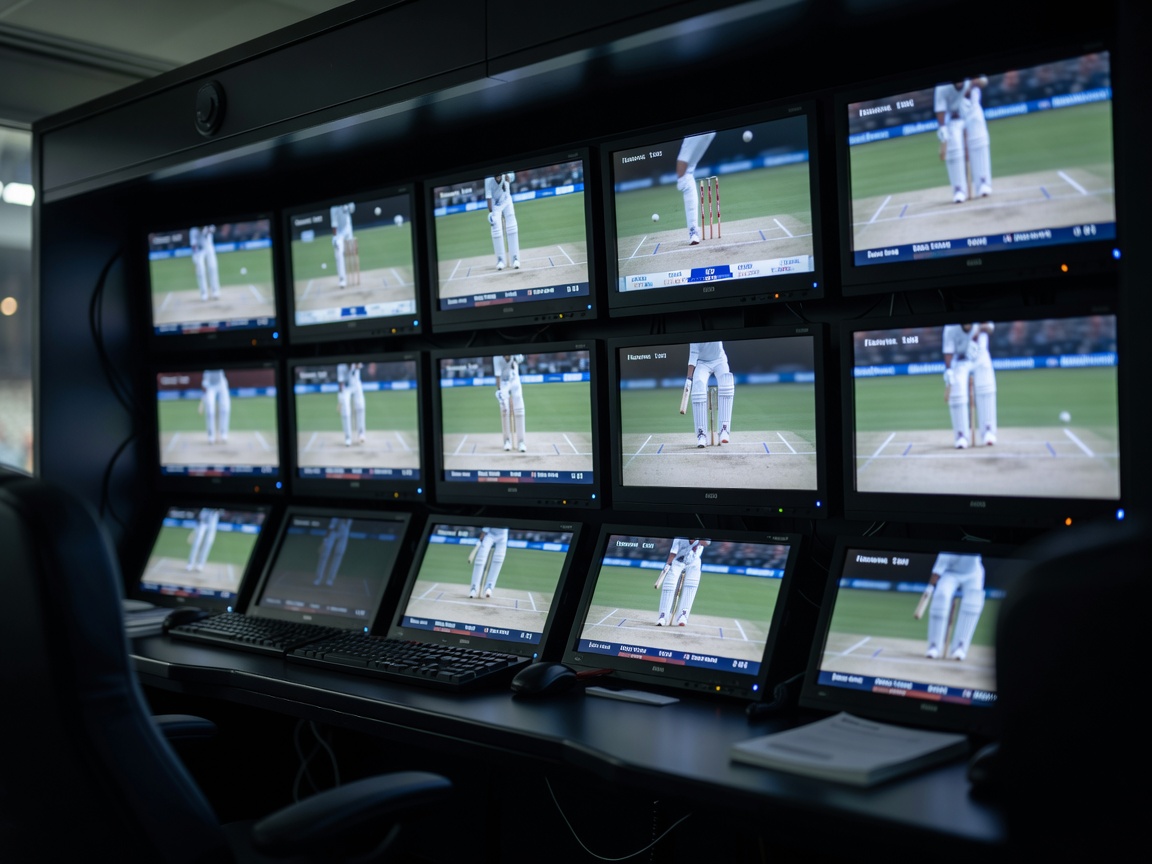
The technology behind a review
- Ball-tracking (Hawk-Eye or Virtual Eye): six or more high-speed cameras record the ball's flight and project where it would have travelled after hitting the pad.
- UltraEdge / Snickometer: a stump microphone waveform synchronised with the video. A sharp spike as the ball passes the bat suggests contact.
- Hot Spot: infrared cameras that show a white friction mark where the ball touched bat or pad. It is expensive and is not used in every series — the IPL, for example, relies on UltraEdge instead.
- Broadcast replays including super slow-motion and side-on cameras for run outs, stumpings and boundary checks.
Who can review, and how many times
Only the fielding captain or the batter who has been given out may ask for a review. They make a "T" shape with their forearms within 15 seconds of the decision. The non-striker may be consulted, and once the third umpire begins the process the request cannot be withdrawn.
| Format | Unsuccessful reviews per innings | Notes |
|---|---|---|
| Test cricket | 3 | Raised from 2 in 2020 |
| One-Day Internationals | 2 | Raised from 1 in 2020 |
| T20 Internationals | 2 | Raised from 1 in 2020 |
| IPL | 2 | 1 review from 2018 to 2022; wides and height no-balls reviewable since 2023 |
A review is only lost if the original decision stands outright. If the result is "Umpire's Call", the team keeps its review.
The third umpire's checklist for an LBW review
- No-ball. If the bowler overstepped, the batter is not out and the review ends.
- Bat involved? UltraEdge is checked as the ball passes the bat. If the ball hit the bat before the pad, it cannot be LBW (though it might still be caught).
- Pitching. The ball must pitch in line with the stumps or on the off side. If it pitched outside leg stump, it is not out.
- Impact. The ball must strike the batter in line with the stumps — unless the batter offered no shot, in which case impact outside off stump is allowed.
- Wickets. Would the ball have gone on to hit the stumps?
Umpire's Call, in plain English
Ball-tracking has a small margin of error, so the ICC decided the on-field umpire's judgement should stand whenever the technology is not clearly certain. For pitching and impact, if less than half the ball is inside the relevant zone, the result is Umpire's Call. For the wickets, the zone is the outline of the stumps, from the outside of off stump to the outside of leg stump and up to the top of the bails (raised from the bottom of the bails in 2021). If the centre of the ball is outside that zone but part of the ball is still clipping the stumps, it is Umpire's Call.
Why the same delivery can be out for one team and not the other
Imagine a ball that would clip the outer half of off stump. If the umpire gave it out, Umpire's Call means it stays out. If the umpire gave it not out, Umpire's Call means it stays not out. The technology is the same; only the original decision differs. That is the single most common source of DRS frustration, and it is working exactly as designed.
Reviews nobody has to ask for
Not every trip to the third umpire is a player review. On-field umpires can refer run outs, stumpings, catches close to the ground and boundary calls at any time. The "soft signal", where the on-field umpire's first instinct guided a catch decision, was removed in 2023. Since 2020 the third umpire has also checked the front foot on every single delivery, which is why you rarely see an on-field umpire call a front-foot no-ball anymore.
What DRS does well
- Removes obvious errors ("howlers")
- Shows fans the evidence in real time
- Protects umpires from the worst criticism
- Adds a tactical layer to captaincy
Where it draws criticism
- Umpire's Call feels inconsistent to viewers
- Each review takes two to three minutes
- Hot Spot is not available everywhere
- Teams sometimes "gamble" reviews late in an innings
Tips for watching a review
Watch the UltraEdge waveform first: a spike that lines up exactly with the ball passing the bat suggests an edge, while a spike a frame later is usually bat hitting pad. On the ball-tracking graphic, three red boxes mean out; a red, red and blue "Umpire's Call" combination means the original decision stands. Broadcasters show a running count of reviews remaining in the corner of the screen, which becomes very important in the last few overs of a tight chase.