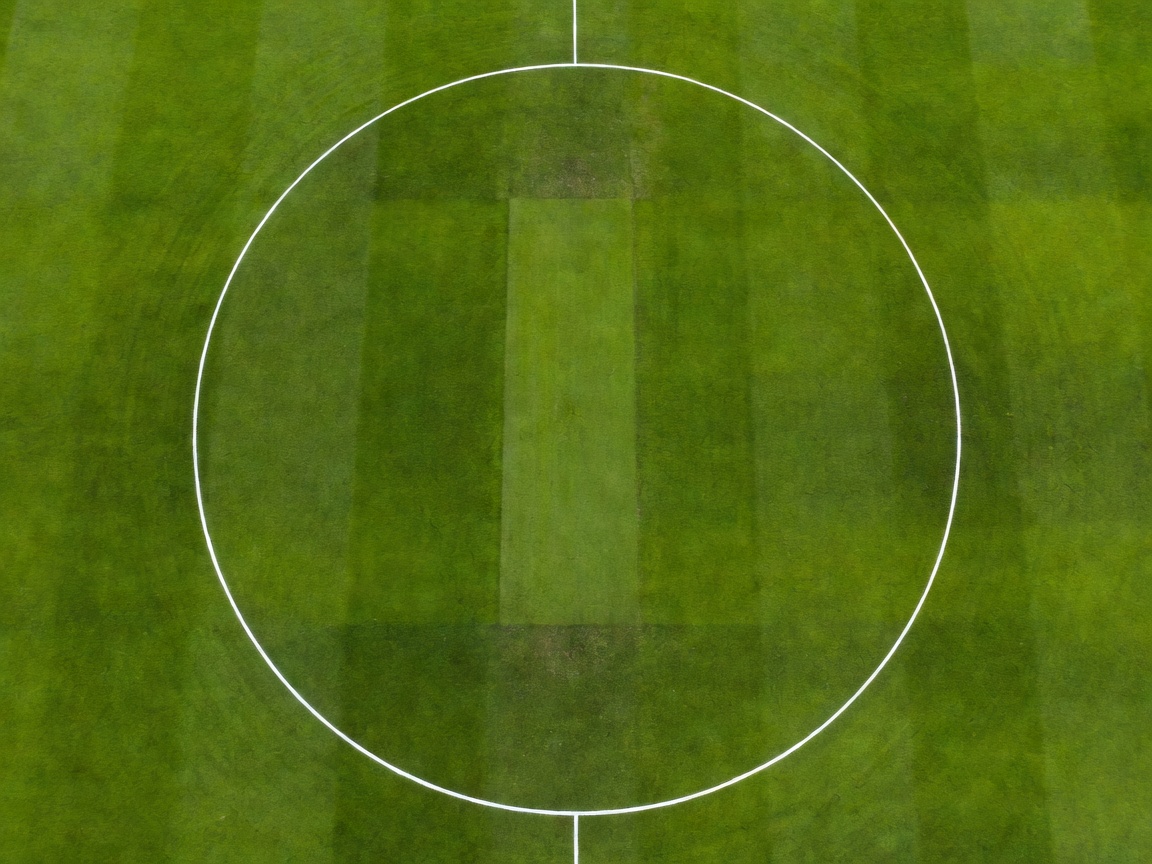
What the 30-yard circle is
Look at the outfield and you will see a white oval around the pitch. It is drawn using two semicircles with a radius of 30 yards (27.4 metres), one centred on each set of stumps, joined by straight lines. Fielders inside it are "in the ring"; fielders outside it are "in the deep" or "on the boundary". Every powerplay rule is simply a cap on how many players may stand outside that line at the moment the ball is bowled.
T20 powerplays: the IPL and T20 Internationals
In a full 20-over match the powerplay is the first six overs. During those overs the fielding side may place no more than two fielders outside the circle. From the seventh over onward the limit rises to five outside the circle, which means at least four must stay inside (plus the bowler and wicketkeeper).
Because the boundary is so lightly guarded, openers are expected to attack. A powerplay score of 50 to 60 without losing more than one wicket is considered a good start in the IPL; in the 2024 season several teams averaged above 60, and Sunrisers Hyderabad passed 100 in six overs more than once. A bowling side that takes two wickets in the powerplay has usually won the phase even if it leaks a few boundaries.
ODI powerplays: three phases
Fifty-over cricket splits the innings into three mandatory blocks. Unlike in the past, the batting side no longer gets to choose when a powerplay happens.
| Phase | Overs | Max fielders outside the circle |
|---|---|---|
| Powerplay 1 | 1–10 | 2 |
| Powerplay 2 | 11–40 | 4 |
| Powerplay 3 | 41–50 | 5 |
These numbers date from a 2015 rule change. Before that, ODIs had a five-over "batting powerplay" that the batting captain could call, and only four fielders were allowed out during the final ten overs. The ICC scrapped the batting powerplay and allowed a fifth outfielder at the death to give bowlers some relief after a run of 400-plus totals.
Restrictions that apply for the whole match
Powerplays get the attention, but several fielding rules apply from the first ball to the last, in every format:
- No more than two fielders behind square on the leg side. This is a Law of the game, introduced after the "Bodyline" series of 1932–33, and a breach is a no-ball.
- No more than five fielders on the leg side at any time in limited-overs cricket.
- The wicketkeeper must stay behind the stumps until the ball touches the bat or batter, or passes the stumps.
- Fielders may not stand on the pitch or move significantly while the bowler is running in.
If any restriction is broken the umpire calls a no-ball, the batting side gets a penalty run and, in T20s and ODIs, the next delivery is a free hit.
What happens when rain shortens the match
Powerplay overs scale down with the length of the innings. In T20 cricket the ICC publishes a fixed table:
| Overs per side | Powerplay overs |
|---|---|
| 5–8 | 2 |
| 9–11 | 3 |
| 12–14 | 4 |
| 15–18 | 5 |
| 19–20 | 6 |
In ODIs the three phases are rescaled to roughly 20 percent, 60 percent and 20 percent of the available overs, so a 20-over ODI would have Powerplay 1 in overs 1–4, Powerplay 2 in overs 5–16 and Powerplay 3 in overs 17–20.
How teams use the powerplay
Batting sides aim to clear the infield rather than the boundary. With only two fielders out, a well-timed lofted shot over mid-off or mid-wicket is almost always four. Bowling sides use their most skilful bowlers: swing bowlers with the new ball, or a spinner such as Ravichandran Ashwin or Sunil Narine to take pace off the ball and make the lofted shot riskier.
Why fans like powerplays
- Guaranteed early action and boundaries
- Clear phases make a match easier to follow
- Rewards brave batting and skilful bowling
Common criticisms
- Bowlers have little protection on flat pitches
- Rescaled overs in rain-hit games can feel arbitrary
- Fielding breaches are hard to spot without replays
What to watch for as a beginner
When the sixth over ends in a T20, watch the field "spread": three extra fielders jog out toward the rope, and the batting tempo usually drops for a few overs while new gaps are found. Broadcasters mark the phase with a "PP" or "P1/P2/P3" tag next to the score. If you see the umpire signal a no-ball when the ball looked perfectly legal, count the fielders — it was probably a restriction breach.